


SYIRKAH: Jurnal Ekonomi Syariah is a peer-reviewed, open-access scholarly journal published by Universitas Muhammadiyah Lampung, Indonesia. The journal provides an academic platform for researchers, scholars, practitioners, and policymakers to disseminate original research and advance scholarly discussions in economics, finance, banking, business, management, and related disciplines.
The journal welcomes both Islamic and conventional economic perspectives, including interdisciplinary research that contributes to theoretical development, empirical knowledge, policy formulation, and sustainable economic practices.
SYIRKAH covers a broad range of topics, including Islamic economics, Islamic banking and finance, zakat, waqf, Islamic social finance, economic development, financial inclusion, entrepreneurship, halal industries, digital economy, financial technology, corporate governance, green economy, and contemporary economic issues.
The journal applies a double-blind peer-review process and is committed to academic integrity, publication ethics, editorial independence, and the dissemination of high-quality scholarly research.
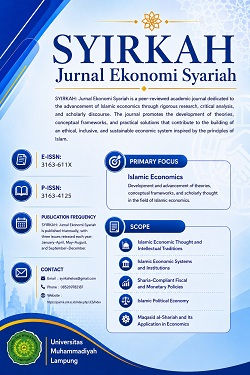
SYIRKAH is published three times annually (triannually), covering January–April, May–August, and September–December.
All published articles are freely accessible under the Creative Commons Attribution-ShareAlike 4.0 International License (CC BY-SA 4.0), with copyright retained by the authors.
....
.
Welcome to SYIRKAH: Jurnal Ekonomi Syariah
SYIRKAH: Jurnal Ekonomi Syariah is a peer-reviewed, open-access scholarly journal published by Universitas Muhammadiyah Lampung, Indonesia. The journal serves as an academic platform for disseminating original research, advancing theoretical and empirical knowledge, and promoting scholarly discussions in Islamic economics, conventional economics, finance, banking, business, management, and related disciplines.
Focus and Scope
SYIRKAH welcomes original and high-quality scholarly contributions covering Islamic economics and economic thought, Islamic banking and finance, Islamic capital markets, zakat, waqf, Islamic social finance, business management, entrepreneurship, halal industries, accounting, corporate governance, financial regulation, digital economy, financial technology, economic development, financial inclusion, green economy, and sustainable development. The journal also encourages interdisciplinary research and studies in conventional economics, finance, and business that offer significant theoretical, empirical, or practical contributions.
Publication and Editorial Information
SYIRKAH is published three times annually (triannually), covering the publication periods of January–April, May–August, and September–December. Articles may be published at any time within their respective publication periods, subject to the completion of editorial and production processes.
All submitted manuscripts undergo initial editorial screening and a double-blind peer-review process involving at least two independent reviewers. The journal is committed to maintaining academic integrity, editorial independence, transparency, and ethical publication practices.
SYIRKAH provides immediate open access to all published articles, allowing readers worldwide to access scholarly research without subscription fees or registration requirements. Authors retain the copyright of their published works, which are distributed under the Creative Commons Attribution-ShareAlike 4.0 International License (CC BY-SA 4.0).
Call for Papers
SYIRKAH invites researchers, academics, lecturers, practitioners, and postgraduate students from Indonesia and abroad to submit original research articles that contribute to the advancement of economic knowledge, financial practices, business development, and contemporary scholarly discussions.
The journal welcomes manuscripts for consideration in upcoming issues throughout the year. Authors are encouraged to carefully review the journal's Focus and Scope, Author Guidelines, manuscript template, and publication ethics policies before submitting their work through the official online submission system.
Journal Website: https://journal.uml.ac.id/index.php/JES/index
Our Commitment
SYIRKAH is committed to promoting high-quality scholarly publications through rigorous peer review, transparent editorial management, responsible research practices, and the dissemination of accessible academic knowledge. The journal seeks to strengthen national and international scholarly collaboration while contributing to theoretical advancement, evidence-based policymaking, and sustainable economic development.
Vol 2, No 03 (2026): SYIRKAH: Jurnal Ekonomi Syariah
Table of Contents
Articles
|
Devita Rizkyani Putri (STAI Pelita Nusa Bandung Barat), Fierlie Shaghiera Nasta (STAI Pelita Nusa Bandung Barat), Nabila Nurina (STAI Pelita Nusa Bandung Barat), Khilda Sania Azzahro (STAI Pelita Nusa Bandung Barat), Tias Riska Nur Azizah(STAI Pelita Nusa Bandung Barat)
|
01-14
|
|
Harlien Rohmawati (Universitas Trunojoyo), Moh. Danial Ismail (Universitas Trunojoyo), Rina Nur Vadila Vadila (Universitas Trunojoyo), Ahmad Nawawi Fadli (Universitas Trunojoyo), Siti Zubaidah (Universitas Trunojoyo)
|
15-23
|
|
Wila Ilmia Ilmia (STAI Nurul Falah Air Molek), Desmi Satriana (STAI Nurul Falah Air Molek)
|
24-35
|
|
Fahri Ikhsan Fauzi (Universitas Siliwangi)
|
36-41
|
|
Tias Riska Nur Azizah (STAI Pelita Nusa Bandung Barat)
|
42-48
|
|
Rindu Wirdhatusifa Wass (STAI Nurul Falah Air Molek), Novri Susanti Suparman (STAI Nurul Falah Air Molek)
|
49-58
|
|
Marisa Oktaria Mahendi (UIN Raden Intan Lampung), Muhammad Fikri Arfandi (UIN Raden Intan Lampung)
|
59-67
|
|
Lira Septia Marsanda (STAI Nurul Falah Air Molek), Muhammad Apis Daulay (STAI Nurul Falah Air Molek)
|
68-75
|
|
Cindi Antika (STAI Nurul Falah Air Molek), Muhammad Apis Daulay (STAI Nurul Falah Air Molek)
|
76-88
|
|
Rafly Imnda (STAI Nurul Falah Air Molek), Muhammad Apis Daulay (STAI Nurul Falah Air Molek)
|
89-95
|
|
Khairatul Umuri (UIN Sultanah Nahrahsiyah Lhokseumawe), Muhammad Syafril Nasution (UIN Sultanah Nahrahsiyah Lhokseumawe)
|
96-106
|
|
Fanesa Ahzara (UIN Sultanah Nahrahsiyah Lhokseumawe), Muhammad Syafril Nasution (UIN Sultanah Nahrahsiyah Lhokseumawe)
|
107-112
|
|
Muhammad Muttaqin Sulistyo (STAI Nurul Falah Air Molek), Muhammad Apis Daulay (STAI Nurul Falah Air Molek)
|
113-119
|
|
Analisis Penggunaan QRIS dalam Meningkatkan Efisiensi Transaksi pada UMKM Perspektif Ekonomi Syariah
Ega Dandaka Awie (STAI Nurul Falah Air Molek), Muhammad Apis Daulay (STAI Nurul Falah Air Molek)
|
120-128
|
|
Asi Sahara (STAI Nurul Falah Air Molek), Muhammad Apis Daulay (STAI Nurul Falah Air Molek)
|
129-137
|
|
Pujiawati Astuti Astuti (STAI Pelita Nusa Bandung Barat), Parida Ridiyanto (STAI Pelita Nusa Bandung Barat), Novita Dwi Puji Lestari (STAI Pelita Nusa Bandung Barat), Devita Nur Vadila (STAI Pelita Nusa Bandung Barat), Dede Elsa Nursafitri (STAI Pelita Nusa Bandung Barat)
|
138-149
|
|
Diah Ayu Rahmawati (STAI Nurul Falah Air Molek), Muhammad Apis Daulay (STAI Nurul Falah Air Molek)
|
150-157
|
|
Ikhsan Ali Akbar (STAI Nurul Falah Air Molek), Muhammad Apis Daulay (STAI Nurul Falah Air Molek)
|
158-163
|
|
Cut Norasyikin (UIN Sultanah Nahrasiyah Lhokseumawe), Dian Amelia (UIN Sultanah Nahrasiyah Lhokseumawe), Muhammad Syafril Nasution (UIN Sultanah Nahrasiyah Lhokseumawe)
|
164-172
|
|
Adellya Fany Azzahra (UIN Sultanah Nahrasiyah Lhokseumawe), Muhammad Syafril Nasution (UIN Sultanah Nahrahsiyah Lhokseumawe)
|
173-178
|
|
Anggun Citra Lestari (UIN Sayyid Ali Rahmatullah Tulungagung), Jecika Chelchie Waritma (UIN Sayyid Ali Rahmatullah Tulungagung), Lailatul Oktavyanti (UIN Sayyid Ali Rahmatullah Tulungagung), Mokhamad Rizky Fadillah (UIN Sayyid Ali Rahmatullah Tulungagung), Amalia Nuril Hidayati (UIN Sayyid Ali Rahmatullah Tulungagung)
|
179-189
|
|
Wila Ilmia (STAI Nurul Falah Air Molek), Muhammad Apis Daulay (STAI Nurul Falah Air Molek)
|
190-204
|
|
Muhammad Fatihul Haq (UIN Sultanah Nahrasiyah Lhokseumawe), Adellya Fany Azzahra (UIN Sultanah Nahrasiyah Lhokseumawe), Ade Rivaldi (UIN Sultanah Nahrasiyah Lhokseumawe), Husni Kamal (UIN Sultanah Nahrasiyah Lhokseumawe)
|
205-219
|
|
Inda Fitriani (UIN Sultanah Nahrasiyah Lhokseumawe), Isra Maulina (UIN Sultanah Nahrasiyah Lhokseumawe)
|
220-232
|

 |  |  |  |
 |  |  |  |
 |  |  |  |

 |  |  |  |
Editor and Administration Address:
SYIRKAH: Jurnal Ekonomi Syariah is published by the Faculty of Islamic Studies, Universitas Muhammadiyah Lampung
Jl. ZA. Pagar Alam, Labuhan Ratu, Kec. Kedaton, Bandar Lampung, Lampung, Indonesia, 35132

SYIRKAH: Jurnal Ekonomi Syariah © 2024 by the Faculty of Islamic Studies, Universitas Muhammadiyah Lampung is licensed under CC BY-SA 4.0

