


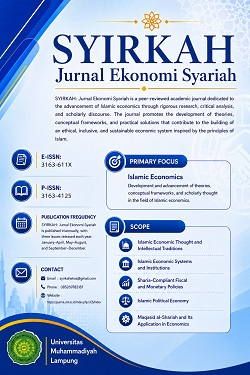
About the Journal: SYIRKAH: Jurnal Ekonomi Syariah is a peer-reviewed academic journal dedicated to the advancement of Islamic economics through rigorous research, critical analysis, and scholarly discourse. The journal promotes the development of theories, conceptual frameworks, and practical solutions that contribute to the building of an ethical, inclusive, and sustainable economic system inspired by the principles of Islam. Published by the Faculty of Islamic Studies, Universitas Muhammadiyah Lampung, SYIRKAH serves as a scholarly platform for academics, researchers, practitioners, and policymakers to disseminate original research and engage in meaningful discussions on contemporary issues in Islamic economics. The journal applies a rigorous peer-review process to ensure academic quality, scientific integrity, and relevance to the field. SYIRKAH is published triannually, with three issues released each year: January–April, May–August, and September–December.
INFORMATION FOR AUTHORS
Dear Authors of SYIRKAH: Jurnal Ekonomi Syariah
As part of our continuous commitment to improving the quality, visibility, and international reputation of the journal, SYIRKAH is currently undergoing the journal accreditation process and preparing for broader international indexing. To support this development, starting from Volume 03 Issue 01 of 2026, the journal accepts and publishes manuscripts written in either English or Indonesian.
To ensure consistency and compliance with international academic publishing standards, all submitted manuscripts must adhere to the following requirements:
- Manuscripts should contain approximately 5,000–8,000 words, including tables, figures, references, and appendices.
- The maximum acceptable Similarity Index is 25%, excluding references and properly cited quotations, as verified through plagiarism detection software.
- Manuscripts authored or co-authored by international scholars are highly encouraged and may receive publication priority.
- Abstracts must be written in both English and Indonesian, consist of 120–250 words, and clearly present the purpose, method, findings, and implications of the study.
- Authors must provide 3–5 keywords arranged alphabetically and separated by semicolons (;).
- The Introduction should include the research background, research problem, review of relevant literature, research gap, novelty, research objectives, and research significance.
- The Research Method section should clearly describe the research design, data sources, population and sample or informants, data collection procedures, and data analysis techniques.
- The Results and Discussion section should present research findings systematically and discuss them by relating findings to theory, previous studies, and their academic and practical implications.
- The Conclusion should summarize the main findings, address the research objectives, highlight the contribution of the study, acknowledge research limitations, and provide recommendations for future research.
- Manuscripts must contain a minimum of 15 references, with at least 80% derived from peer-reviewed journal articles.
- At least 60% of the references should be sourced from international journals published within the last ten years.
- All citations and references must follow the Chicago Manual of Style, 17th Edition (Author–Date), and should be managed using Mendeley Desktop, Zotero, or other compatible reference management software.
- Authors are encouraged to prioritize primary sources, recent scholarly publications, and literature directly relevant to the research topic.
- Manuscripts that do not comply with the journal's submission guidelines and publication standards may be returned for revision or declined for further review.
To improve publication efficiency, SYIRKAH aims to reduce the review and publication process from approximately six months to a maximum of two to three months. To support journal operations and publication quality, the Editorial Board may implement an Article Processing Charge (APC) policy in the future. Any applicable APC information will be announced separately through the journal's official website.
We sincerely appreciate your contribution to the advancement of Islamic economics scholarship and look forward to receiving high-quality manuscripts from researchers, academics, and practitioners worldwide.
Editorial Team
SYIRKAH: Jurnal Ekonomi Syariah
Vol 2, No 03 (2026): SYIRKAH: Jurnal Ekonomi Syariah
Table of Contents
Articles
|
Devita Rizkyani Putri (STAI Pelita Nusa Bandung Barat), Fierlie Shaghiera Nasta (STAI Pelita Nusa Bandung Barat), Nabila Nurina (STAI Pelita Nusa Bandung Barat), Khilda Sania Azzahro (STAI Pelita Nusa Bandung Barat), Tias Riska Nur Azizah(STAI Pelita Nusa Bandung Barat)
|
01-14
|
|
Harlien Rohmawati (Universitas Trunojoyo), Moh. Danial Ismail (Universitas Trunojoyo), Rina Nur Vadila Vadila (Universitas Trunojoyo), Ahmad Nawawi Fadli (Universitas Trunojoyo), Siti Zubaidah (Universitas Trunojoyo)
|
15-23
|
|
Wila Ilmia Ilmia (STAI Nurul Falah Air Molek), Desmi Satriana (STAI Nurul Falah Air Molek)
|
24-35
|
|
Fahri Ikhsan Fauzi (Universitas Siliwangi)
|
36-41
|
|
Tias Riska Nur Azizah (STAI Pelita Nusa Bandung Barat)
|
42-48
|
|
Rindu Wirdhatusifa Wass (STAI Nurul Falah Air Molek), Novri Susanti Suparman (STAI Nurul Falah Air Molek)
|
49-58
|
|
Marisa Oktaria Mahendi (UIN Raden Intan Lampung), Muhammad Fikri Arfandi (UIN Raden Intan Lampung)
|
59-67
|
|
Lira Septia Marsanda (STAI Nurul Falah Air Molek), Muhammad Apis Daulay (STAI Nurul Falah Air Molek)
|
68-75
|
|
Cindi Antika (STAI Nurul Falah Air Molek), Muhammad Apis Daulay (STAI Nurul Falah Air Molek)
|
76-88
|
|
Rafly Imnda (STAI Nurul Falah Air Molek), Muhammad Apis Daulay (STAI Nurul Falah Air Molek)
|
89-95
|
|
Khairatul Umuri (UIN Sultanah Nahrahsiyah Lhokseumawe), Muhammad Syafril Nasution (UIN Sultanah Nahrahsiyah Lhokseumawe)
|
96-106
|
|
Fanesa Ahzara (UIN Sultanah Nahrahsiyah Lhokseumawe), Muhammad Syafril Nasution (UIN Sultanah Nahrahsiyah Lhokseumawe)
|
107-112
|
|
Muhammad Muttaqin Sulistyo (STAI Nurul Falah Air Molek), Muhammad Apis Daulay (STAI Nurul Falah Air Molek)
|
113-119
|
|
Analisis Penggunaan QRIS dalam Meningkatkan Efisiensi Transaksi pada UMKM Perspektif Ekonomi Syariah
Ega Dandaka Awie (STAI Nurul Falah Air Molek), Muhammad Apis Daulay (STAI Nurul Falah Air Molek)
|
120-128
|
|
Asi Sahara (STAI Nurul Falah Air Molek), Muhammad Apis Daulay (STAI Nurul Falah Air Molek)
|
129-137
|
|
Pujiawati Astuti Astuti (STAI Pelita Nusa Bandung Barat), Parida Ridiyanto (STAI Pelita Nusa Bandung Barat), Novita Dwi Puji Lestari (STAI Pelita Nusa Bandung Barat), Devita Nur Vadila (STAI Pelita Nusa Bandung Barat), Dede Elsa Nursafitri (STAI Pelita Nusa Bandung Barat)
|
138-149
|
|
Diah Ayu Rahmawati (STAI Nurul Falah Air Molek), Muhammad Apis Daulay (STAI Nurul Falah Air Molek)
|
150-157
|
|
Ikhsan Ali Akbar (STAI Nurul Falah Air Molek), Muhammad Apis Daulay (STAI Nurul Falah Air Molek)
|
158-163
|
|
Cut Norasyikin (UIN Sultanah Nahrasiyah Lhokseumawe), Dian Amelia (UIN Sultanah Nahrasiyah Lhokseumawe), Muhammad Syafril Nasution (UIN Sultanah Nahrasiyah Lhokseumawe)
|
164-172
|
|
Adellya Fany Azzahra (UIN Sultanah Nahrasiyah Lhokseumawe), Muhammad Syafril Nasution (UIN Sultanah Nahrahsiyah Lhokseumawe)
|
173-178
|
|
Anggun Citra Lestari (UIN Sayyid Ali Rahmatullah Tulungagung), Jecika Chelchie Waritma (UIN Sayyid Ali Rahmatullah Tulungagung), Lailatul Oktavyanti (UIN Sayyid Ali Rahmatullah Tulungagung), Mokhamad Rizky Fadillah (UIN Sayyid Ali Rahmatullah Tulungagung), Amalia Nuril Hidayati (UIN Sayyid Ali Rahmatullah Tulungagung)
|
179-189
|
|
Wila Ilmia (STAI Nurul Falah Air Molek), Muhammad Apis Daulay (STAI Nurul Falah Air Molek)
|
190-204
|
|
Muhammad Fatihul Haq (UIN Sultanah Nahrasiyah Lhokseumawe), Adellya Fany Azzahra (UIN Sultanah Nahrasiyah Lhokseumawe), Ade Rivaldi (UIN Sultanah Nahrasiyah Lhokseumawe), Husni Kamal (UIN Sultanah Nahrasiyah Lhokseumawe)
|
205-219
|
|
Inda Fitriani (UIN Sultanah Nahrasiyah Lhokseumawe), Isra Maulina (UIN Sultanah Nahrasiyah Lhokseumawe)
|
220-232
|

 |  |  |  |
 |  |  |  |
 |  |  |  |

 |  |  |  |
Editor and Administration Address:
SYIRKAH: Jurnal Ekonomi Syariah is published by the Faculty of Islamic Studies, Universitas Muhammadiyah Lampung
Jl. ZA. Pagar Alam, Labuhan Ratu, Kec. Kedaton, Bandar Lampung, Lampung, Indonesia, 35132

SYIRKAH: Jurnal Ekonomi Syariah © 2024 by the Faculty of Islamic Studies, Universitas Muhammadiyah Lampung is licensed under CC BY-SA 4.0

